
It’s no secret that racing is an expensive endeavor–to the point of cliche. But there are a few remaining pockets of truly accessible racing that exist in the United States today, of which (in the author’s humble opinion), the best is the simple, down-and-dirty local dirt oval track. Screaming V-8 motors, wheel to wheel (and sometimes open wheel) action, and sliding. So much sliding. Sliding through all four turns to the point one can’t tell where the straights actually begin or end. It’s a lot like if NASCAR and Formula D had a redneck stepchild, and then it had a teen rebellion where it got a nose ring and colored its hair green.
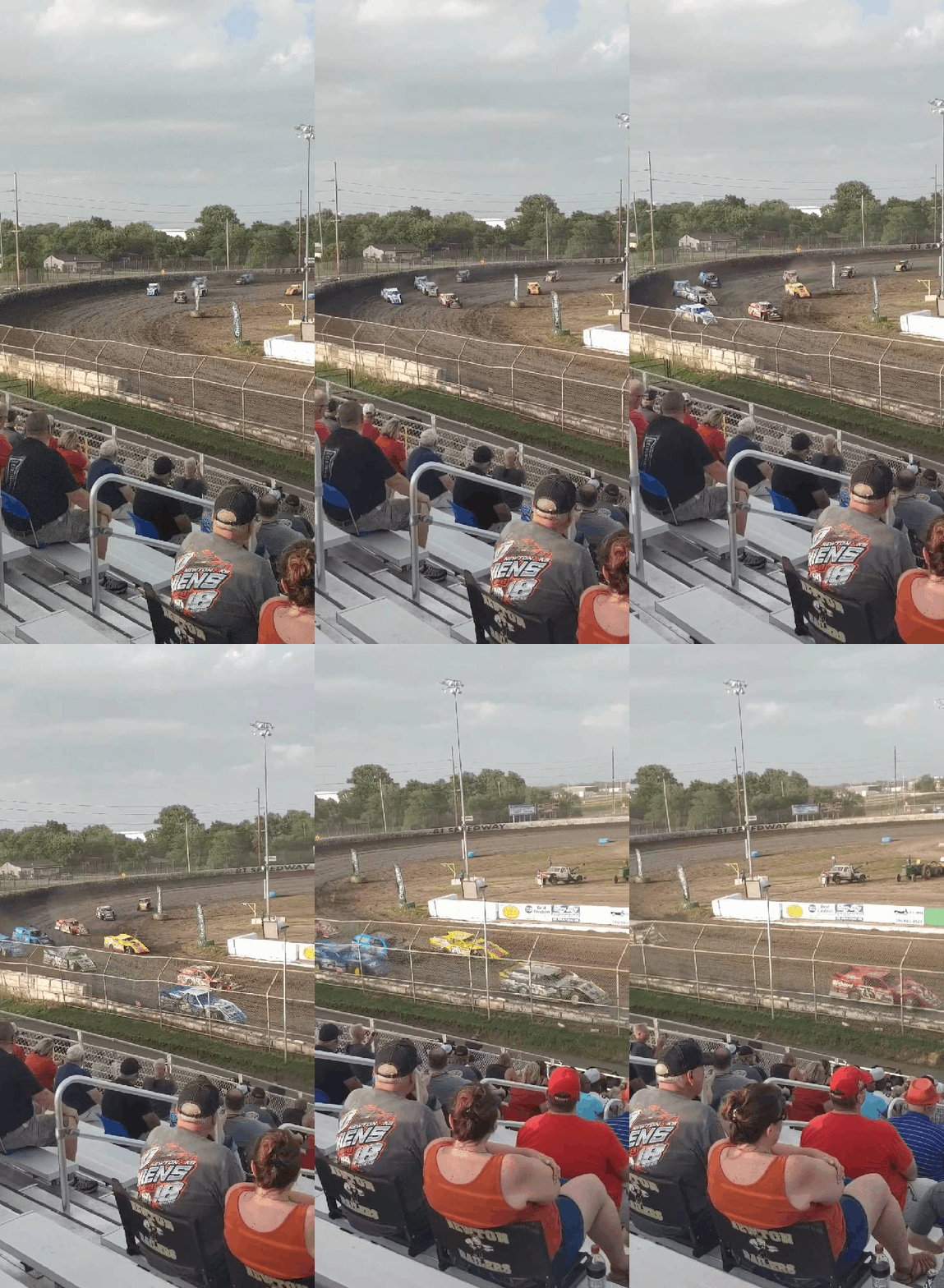
A few weeks ago, I watched two co-workers take dirt modifieds to different levels of success–one with his first top-5 finish at this track in a B-Mod, the other in an A-Mod on track to a podium finish if not for some extracurriculars after a caution that would ultimately end in with a DNF. But the so-called “ruined” race didn’t matter. A couple of days later at work I asked him about his race, and rather than a scowl and some grumbling, I got the biggest smile you’ve ever seen, despite being 5 laps and a busted tierod away from a 3rd place finish in the A-Main. That’s something I haven’t really experienced in the other “grassroots” motorsports–autocrossers and drag racers are too hungry for the next tenth to have the same fun. I’m not saying it’s not enjoyable, I have close friends who have the times of their lives piloting vehicles in those ways. But there is really no other comparison for cheap wheel-to-wheel racing, at least in the Midwest. Sure, 24 Hours of Lemons and ChumpCar come to the prairie states occasionally, but those can’t even begin to compare to the regularity, camaraderie, or level of competition for relatively little money that the local dirt oval can provide.
There’s something for everyone. At the lower (cheaper) end, you have the Mini-stocks, RWD 4-cylinder American cars. Think notchback Fox Mustangs with the 2.3L, maybe a Chevy Vega that looks like a 3/4 scale late model. They’re not particularly fast, but they scream to about 7600 RPM and still slide the corners with the best of ’em. Then there’s the Stock Cars–intermediate (and sometimes full-size) American V-8 sedans. Limited engine modifications to keep the price way down and the competition close. This is where the Foxbody Thunderbirds and GM G-Body platforms come out to play, with a few Novas sprinkled in and maybe the odd GM Colonnade car or Ford Torino. This class is similarly accessible, but good base cars are becoming rarer and rarer in junkyards every day. However, all one really needs is the frame, as most of these cars have become unrecognizable sheet metal skins stretched over a roll cage. Finally, there’s the modifieds, typically the fastest cars of the night if sprint cars or late models aren’t making their rare appearance. These cars look like something between a stock car and a late model, and drive like it too, albeit with open front wheels. The history of how these cars came to be deserves its own article, so I’ll spare the details here. While modified chassis are largely similar, they are broken down into A- and B-Mods, with 2 main differences. First is the rear suspension. B-Mods are almost always legislated to require 3-link rear axle setups, while A-Mods get 4-link rear ends. This makes the B class a bit more accessible, as there are fewer ways to really screw up chassis dynamics with a 3-link architecture, and as a result it’s a bit easier to remain competitive even with limited experience. The second difference is the engine. B-Mods are typically a crate motor class or have more engine modification restrictions than A-Mod. Meanwhile A-Mods, from a powertrain standpoint at least, seem to be getting closer and closer to Late Models every single year as horsepower wars rage on due to the relative lack of engine modification restrictions.

And then, well, that’s generally it. There are typically no late models, no sprint cars, no “World of Outlaws,” just sponsorships from local trucking companies, a bunch of aviation workers turned race car drivers for a night, and a $1,000 dollar purse for the winner of the A-Main. It’s 7600 RPM 4-cylinder American crapcans, screaming Chevy V-8s and endless sliding and battling for traction for up to 35 laps at a time. The very best part? Dirt track racing is still so accessible that there is probably a dirt oval within an hour of most Americans. And you should find one and go. It really is something to behold. Even better, if the dirt bug bites you hard enough, with enough financial planning, a used race car, and a local mentor, you could feasibly find yourself in the thick of it, wheel to wheel, battling for position on track in one of the last affordable chances to do so in America.
 Burnt Clutches